
How to Build a Tory Burch Capsule Wardrobe
Range is what makes a single-label capsule possible, and this label has it, since ready-to-wear, denim, knitwear, outerwear, bags, shoes and swim all sit under one roof. The risk here is the opposite of scarcity. Because the assortment is broad and the logo is recognisable, it is easy to end up with six versions of the same idea. This piece works outward from a budget rather than inward from a wish list. Every price quoted is an observed market price read on the brand’s own site in September 2026, not an official price list, and figures move with season, market, material and channel. The aim is eight to twelve pieces that go together easily and survive several years.
The Budget Comes First, Before Anything Else
The total comes before the individual numbers, which otherwise expand to fill whatever space you leave them. Observed 2026 prices fall into three usable bands. At the entry band, roughly $95 to $200, you get card cases, cosmetic cases, hair clips, jelly sandals, cotton tanks and the Miller sandal. Roughly $250 to $600 is the core band, covering most sandals, sneakers, loafers, ankle boots, mid-weight knitwear and most leather bags. The top band runs roughly $695 to $995 and covers tall boots, Lee Radziwill bags and tailored outerwear such as a double breasted wool coat at $995. Knowing the band a category belongs to heads off the usual error, which is spending everything on one bag and having nothing to wear it with.
The Anchor Bag
One bag carries the capsule, and it deserves the longest thought. Volume, not style, is the practical question, so a tote for a laptop, a structured satchel if it has to hold shape empty, a crossbody if you carry little. At torry burch flats observed prices, an Ella twist reversible tote is $260, making nylon the cheapest route to a genuinely large bag. Leather moves the numbers up, with a Perry tote or crossbody at $395, a Fleming crossbody at $470, a Fleming carryall at $695, and the Lee Radziwill double bag at $595 petite or $795 small. Model matters less than colour, and a mid-brown, black or deep neutral outlasts a seasonal shade by years. Worth one note on naming, because Kira, Eleanor, Romy, Pierced and Miller are used for bags and for shoes alike, so filter by category.
Two Pairs of Shoes for the Bulk of the Week
Two pairs handle most of a normal week, and the pairing that works is one flat sandal or loafer plus one closed shoe. Introduced in 2008, the Miller thong sandal is the recognisable entry point at an observed $200, while the cushioned Miller Cloud sandal is $225 and the lighter Miller Cloud Light $150. The Ines slide, also $225, delivers the same idea in a quieter logo. On the closed-shoe side, the classic loafer and LeeLee loafer are observed at $325 and field sneakers at $250. The Reva ballet flat was paused in 2017 and relaunched in 2025 as a redesign, and reports put it at roughly $330 to $350 against its original $195, so it now sits alongside loafers instead of below them. Come autumn, the third pair is the Romy Chelsea boot at $395 rather than a second sandal.
The Clothes: Knitwear, Denim and One Dress
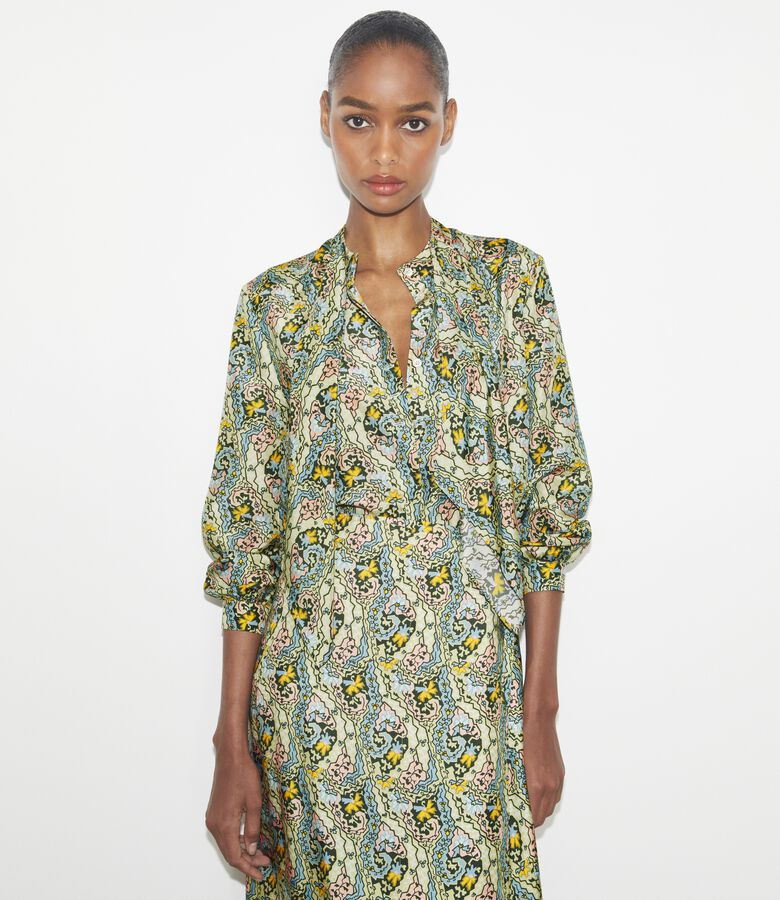
Ready-to-wear is where a capsule earns its keep, and three categories do most of the work. Rather than a licence, denim is a genuine in-house category, with a slim leg jean observed at $350, a wide leg jean at $395, and one pair that fits properly holding together more outfits than anything else. Knitwear is the second pillar, with a merino wool turtleneck at $420 and a T Monogram jacquard cardigan at $550. One dress covers what the first two cannot, and a printed viscose jersey dress at $550 travels further than a more decorative option. Below that sit cotton scoop tanks and ribbed tank tops at $150, which make tory burch clothing you already own more wearable. Elevated American sportswear with an off-kilter femininity is the house style, so let the plain pieces carry the printed ones.
Outerwear and the Single Expensive Decision
Every capsule contains one item that costs more than it appears to deserve, and here it is usually the coat. The range tops out with a double breasted wool coat observed at $995, a corduroy blazer at $750 sitting under it. Arithmetic rather than aspiration makes the case for spending here, since a coat covers almost everything else and wears out slowly. Against that, it competes with specialist outerwear makers and deserves judging on cut and cloth rather than label. If the budget cannot carry both a coat and an anchor bag, buy the bag first, because a bag works year-round. A blazer is the compromise, since it functions as outerwear indoors and as a layer outdoors.
Three Costed Routes
The routes below are built from observed September 2026 prices and are shapes rather than shopping lists. Each route is internally consistent, so every piece works with every other piece in its row. Leaning on nylon and the entry shoe band, the starter route buys a wearable capsule for a little over a thousand dollars. The considered route roughly doubles that, swapping nylon for leather and adding a second bag and better knitwear. The full route accepts the top band twice, once for the coat and once for the bag. Tax, alterations and shoe protection sit outside these totals, all of which assume full price, and the next section argues against paying it.
| Route name | The pieces | Total at observed 2026 prices |
|---|---|---|
| Starter route | Ella twist reversible tote $260, Miller sandal $200, field sneaker $250, cotton scoop tank $150, slim leg jean $350 | $1,210 all in |
| Considered route | Fleming crossbody $470, Perry tote $395, classic loafer $325, Miller Cloud sandal $225, wide leg jean $395, merino turtleneck $420 | Total of $2,230 |
| Full | Double breasted wool coat $995, small Lee Radziwill double bag $795, Romy ankle boot $495, wool V-neck sweater $495, classic loafer $325, T Monogram straight leg jean $395 | $3,500 all in |
Timing: Where the Discounts Really Sit
Building this at full price in one month is unnecessary. The brand holds a recurring semi-annual sale, with coverage of the July 2026 edition reporting sandals under $100 and reductions of up to about half, while the deeper claims of up to seventy percent sit in promotional copy and guarantee nothing. There is also a separate private sale gated to account holders, reported to run roughly twice a year, although that cadence is unconfirmed. A physical tory burch outlet network exists in premium outlet centres, but the company states plainly that it operates no online outlet, so any site advertising itself as one is not the brand. In 2026 the off-price picture changed, since Nordstrom Rack and TJ Maxx continue to carry the label and remain legitimate, whereas Saks OFF 5TH closed its e-commerce operation altogether after Saks Global’s bankruptcy earlier in the year. The pieces that rarely discount are worth full price, so wait for the rest, and do it in this order.
- First the anchor bag, neutral in colour, at whatever it costs.
- A single pair of closed shoes, tried on in person for fit.
- Denim next, since fit decides everything and returns are tedious.
- Knitwear in a genuine tory burch sale, when seasonal markdowns run deepest.
- Sandals late in summer, as the semi-annual event lands.
- Coat at the end, and only once the rest already works.
What to Know on Fit, Sizing and Returns
Fit is the largest single cause of a wasted purchase here, and buyer reports are consistent enough to plan around. Across long-running buyer threads, tory burch shoes are described as running narrow line-wide, which is buyer consensus rather than brand policy. Most often the Miller sandal is called slightly small and narrow, the usual advice being half a size up, and a wide width does exist for it. The Reva collects mixed reports, with some finding it true to size, many going up half a size, and the common view calling it shallow and narrow through the toe box. A wide version exists for some styles, including the Ines slide, so check before assuming a style is closed to you. Where you can, buy knitwear and denim in person, because sale garments are often final sale.
What Stays Out
A capsule is defined as much by refusals as by purchases. Leave out the second logo-heavy bag, because two recognisable pieces in one outfit read as a uniform rather than a wardrobe. Leave out seasonal swim and beach pieces unless you genuinely travel for them, since a $470 long linen caftan is a holiday purchase rather than a foundation. Leave fragrance, watches and eyewear out of the capsule maths entirely: fragrance runs under a Shiseido licence effective from the start of 2020 and eyewear under a long-standing Luxottica licence. The runway is not a higher tier, whatever the assumption, because runway pieces feed the same seasonal main collection instead of a separate diffusion line. Fewer, plainer things from tory burch, worn harder, beat buying more.
Cashback returns a percentage of net losses over a defined period, usually weekly. Unlike match bonuses it arrives after play rather than before, which makes it easier to value accurately but also means it only ever triggers on a losing run.
Cashback Compared With Match Bonuses
A rebate paid in cash is worth several times the same percentage paid as bonus credit with wagering attached. Players comparing schemes can betrepublic and check how each operator settles it. The calculation period matters too, since a weekly window and a monthly one produce quite different outcomes from identical play.
| Term | Why It Matters |
|---|---|
| Payment form | Cash beats bonus credit |
| Calculation period | Weekly and monthly differ |
- Compare the effective rate after wagering is applied
- Do not treat a rebate as a reason to play on
Cashback softens losing sessions without ever making them profitable, and it is worth remembering that receiving it means the week went badly. Genuine cash rebates have clear value. Bonus credit with attached wagering mostly encourages another session, which is precisely why operators structure it that way.